What is Vibration Condition Monitoring

Unveiling the Unseen: A Deep Dive into Vibration Condition Monitoring

Imagine a world where your critical machinery could whisper its troubles to you long before a catastrophic breakdown. A world where you could proactively schedule maintenance, optimize performance, and virtually eliminate unexpected downtime. This isn’t a futuristic fantasy; it’s the power of Vibration Condition Monitoring (VCM), a cornerstone of modern industrial maintenance.

In today’s highly competitive industrial landscape, maximizing asset lifespan and ensuring operational efficiency are paramount. Reactive maintenance—fixing things only after they break—is a costly and inefficient approach, leading to lost production, expensive emergency repairs, and potential safety hazards. This is where the proactive, data-driven approach of VCM steps in, transforming maintenance from a necessary evil into a strategic advantage.

what is vibration condition monitoring

The Symphony of Sound (and Silence): What is Vibration?

Before we delve into monitoring, let’s understand the subject itself: vibration. In simple terms, vibration is the oscillatory motion of a machine or component around an equilibrium position. While some level of vibration is normal for rotating machinery, changes in its characteristics—amplitude, frequency, and phase—are often tell-tale signs of developing faults.

Think of a perfectly tuned engine purring smoothly. Its vibrations are consistent and predictable. Now imagine a worn bearing or an unbalanced rotor. These defects introduce new, abnormal vibrations, creating a discordant note in the machine’s otherwise harmonious hum. VCM is essentially about listening for these discordant notes, interpreting their meaning, and predicting when a machine will need attention.

From Reactive to Predictive: The Evolution of Maintenance

To truly appreciate VCM, it’s helpful to consider the evolution of maintenance strategies:

  • Reactive (Breakdown) Maintenance: The “fix-it-when-it-breaks” approach. Simple, but incredibly costly due to unscheduled downtime, secondary damage, and high repair costs.
  • Preventive Maintenance: Scheduled maintenance based on time or usage (e.g., changing oil every 5,000 km). Better than reactive, but can lead to unnecessary maintenance (still good components being replaced) or miss developing issues between scheduled checks.
  • Predictive Maintenance (PdM): This is where VCM shines. PdM uses various techniques (like VCM, thermography, oil analysis) to monitor the actual condition of assets in real-time. This allows for maintenance to be performed only when needed, just before a failure is imminent.
  • Proactive Maintenance: Takes PdM a step further by identifying and addressing the root causes of failures, leading to continuous improvement and extended asset life. VCM plays a crucial role in providing the data for this analysis.

VCM is a core pillar of Predictive Maintenance, empowering organizations to shift from a reactive, crisis-driven approach to a proactive, data-informed strategy.

The Science Behind the Signals: How Vibration Condition Monitoring Works

At its heart, VCM involves measuring, analyzing, and interpreting the vibration signals emitted by machinery. Here’s a simplified breakdown of the process:

  1. Data Acquisition: This is where specialized sensors, primarily accelerometers, are mounted on critical points of the machine. Accelerometers convert mechanical vibrations into electrical signals.
  2. Signal Processing: The raw electrical signals are then processed. This often involves filtering out noise and converting time-domain signals into frequency-domain signals using a Fast Fourier Transform (FFT). The frequency spectrum reveals the amplitude of vibration at different frequencies, which is crucial for diagnosing specific faults.
  3. Data Analysis and Interpretation: This is the diagnostic phase. Trained analysts and specialized software compare the collected vibration data against baseline measurements and established fault patterns. Key parameters analyzed include:
    • Overall Vibration Amplitude: Indicates the general health of the machine. A significant increase often signals a problem.
    • Frequency Signatures: Different machine faults produce unique vibration frequencies. For example:
      • Unbalance: Typically creates strong vibrations at the machine’s running speed (1x RPM).
      • Misalignment: Can generate vibrations at 1x, 2x, or even 3x RPM, often with axial components.
      • Bearing Defects: Produce very specific, high-frequency “fault frequencies” related to the geometry of the bearing components (inner race, outer race, ball, cage).
      • Gear Defects: Generate vibrations at gear mesh frequencies and their harmonics.
      • Looseness: Can manifest as broadband noise or harmonics of running speed.
    • Phase Analysis: Helps differentiate between certain faults, especially unbalance and misalignment.
    • Trend Analysis: Tracking vibration levels over time is critical. A steady increase indicates a worsening condition and helps predict the remaining useful life (RUL) of a component.
  4. Reporting and Recommendations: Based on the analysis, a report is generated outlining the machine’s condition, identified faults, their severity, and recommended maintenance actions.

The Unsung Heroes: Components of a VCM System

A typical VCM system comprises several key components:

  • Accelerometers: The primary sensors for converting mechanical vibration into electrical signals.
  • Data Collectors/Analyzers: Portable devices or online systems that acquire, process, and store vibration data. Portable data collectors are used for periodic routes, while online systems provide continuous monitoring.
  • Vibration Analysis Software: Powerful software platforms that facilitate data storage, trending, spectral analysis, fault diagnosis, and report generation.
  • Trained Analysts: The human element, crucial for interpreting complex data, validating automated diagnoses, and providing actionable recommendations. Their expertise is invaluable.

The Tangible Benefits: Why VCM is a Game-Changer

Implementing a robust VCM program offers a wealth of benefits that directly impact an organization’s bottom line and operational efficiency:

  • Reduced Downtime: By predicting failures, maintenance can be scheduled during planned outages, eliminating costly unplanned downtime.
  • Lower Maintenance Costs: Proactive repairs are generally less expensive than emergency repairs, and VCM helps avoid secondary damage to components.
  • Extended Asset Life: Addressing issues early prevents them from escalating, significantly prolonging the lifespan of valuable machinery.
  • Improved Safety: Identifying potential failures before they become critical reduces the risk of catastrophic breakdowns and associated safety hazards.
  • Optimized Resource Allocation: Maintenance teams can focus their efforts on machines that genuinely need attention, optimizing labor and spare parts inventory.
  • Enhanced Production Quality: Consistent machine performance, free from excessive vibration, can lead to higher quality products.
  • Increased Productivity: Reliable machinery translates directly into higher output and greater overall productivity.
  • Data-Driven Decision Making: VCM provides objective, quantifiable data to support maintenance decisions, leading to more informed strategies.

Beyond the Basics: Advanced VCM Techniques and Considerations

While the core principles remain the same, VCM continues to evolve with technological advancements:

  • Wireless Sensors: Offer easier installation and lower cabling costs, especially in hard-to-reach areas.
  • Cloud-Based Platforms: Enable remote monitoring, data storage, and collaboration, making VCM accessible from anywhere.
  • Artificial Intelligence (AI) and Machine Learning (ML): These technologies are increasingly being integrated into VCM software to automate fault diagnosis, improve predictive accuracy, and identify subtle patterns that human analysts might miss.
  • Integration with CMMS/EAM Systems: Seamless integration with Computerized Maintenance Management Systems (CMMS) or Enterprise Asset Management (EAM) systems streamlines work order generation and asset management.

Key Considerations for a Successful VCM Program:

  • Commitment from Management: Essential for allocating resources and ensuring program sustainability.
  • Skilled Personnel: Investing in training for vibration analysts is crucial.
  • Proper Equipment: Selecting the right sensors, data collectors, and software for your specific machinery and environment.
  • Baseline Data: Establishing initial vibration readings for healthy machines is vital for comparison.
  • Regular Data Collection: Consistency in data acquisition is key for accurate trending.
  • Actionable Reporting: Reports must be clear, concise, and provide actionable recommendations.
  • Continuous Improvement: Regularly review and refine the VCM program based on results and feedback.

The Future is Listening: Embracing the Power of VCM

In an increasingly interconnected and automated industrial world, the ability to predict and prevent machine failures is no longer a luxury but a necessity. Vibration Condition Monitoring is at the forefront of this revolution, offering a powerful and proven methodology for optimizing asset performance, reducing costs, and ensuring operational continuity.

By “listening” to the subtle language of your machinery, VCM empowers you to move beyond reactive firefighting and embrace a proactive, data-driven approach to maintenance. It’s an investment that pays dividends in uptime, efficiency, and peace of mind, allowing your business to thrive in a competitive landscape.

So, the next time you hear a machine humming, remember that within its vibrations lies a wealth of information – information that, with the help of Vibration Condition Monitoring, can unlock a future of unparalleled reliability and performance.

What is IIoT and Solution

In the age of digital transformation, businesses are constantly seeking ways to enhance efficiency, reduce costs, and gain a competitive edge. One of the most impactful technologies enabling these aspirations is the Industrial Internet of Things (IIoT). Far beyond simply connecting devices, IIoT represents a paradigm shift in how industries operate, bringing together the power of operational technology (OT) and information technology (IT) to create intelligent, data-driven ecosystems.

what is iiot

What is IIoT? The Intelligent Backbone of Modern Industry

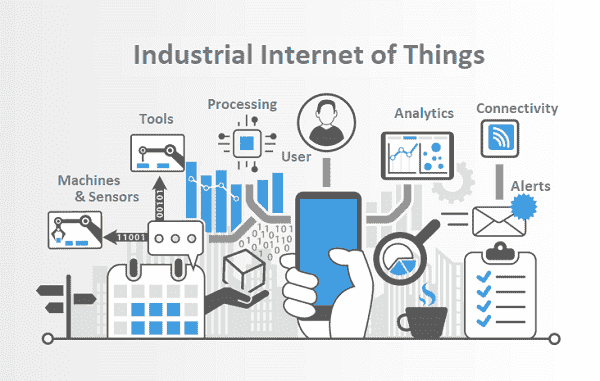
At its heart, the Industrial Internet of Things (IIoT) is a network of interconnected sensors, instruments, and other devices coupled with computers’ industrial applications, including manufacturing and energy management. It’s an extension of the Internet of Things (IoT) but specifically tailored for industrial settings, focusing on machine-to-machine (M2M) communication, big data, machine learning, and automation technologies to create smarter, more efficient industrial processes.

Think of it this way: In a traditional factory, machines operate in silos, performing their functions independently. With IIoT, these machines are equipped with sensors that collect vast amounts of data – on temperature, pressure, vibration, output, and much more. This data is then transmitted, often wirelessly, to a central system where it’s analyzed in real-time. This analysis provides actionable insights, allowing for predictive maintenance, optimized production, improved quality control, and enhanced safety.

Key Components of an IIoT Ecosystem:

Understanding IIoT requires recognizing its fundamental building blocks:

  • Smart Sensors and Devices: These are the data gatherers, embedded within industrial equipment to monitor various parameters. They can range from simple temperature sensors to complex vision systems.
  • Connectivity (Gateways & Networks): This layer ensures seamless data transmission from the devices to the cloud or on-premise servers. It involves various communication protocols like Wi-Fi, Ethernet, cellular (4G/5G), LoRaWAN, and MQTT, often facilitated by IIoT gateways that aggregate data from multiple devices.
  • Data Acquisition and Processing (Edge & Cloud Computing): Once collected, data needs to be processed.
    • Edge Computing: Processing data closer to the source (at the “edge” of the network) reduces latency and bandwidth usage, crucial for real-time applications.
    • Cloud Computing: For larger-scale analysis, historical data storage, and complex AI/ML models, cloud platforms provide scalable and flexible infrastructure.
  • Data Analytics and Artificial Intelligence (AI): This is where the magic happens. Sophisticated algorithms and machine learning models analyze the raw data to identify patterns, predict failures, optimize processes, and generate actionable insights.
  • User Interfaces and Applications: Dashboards, mobile apps, and other software applications visualize the data and insights, allowing operators, managers, and executives to monitor performance, make informed decisions, and control processes remotely.
  • Actuators and Control Systems: Based on the insights, IIoT systems can also trigger actions. Actuators can adjust machine settings, shut down equipment in emergencies, or initiate other automated responses.

The Transformative Power of IIoT: Unlocking Business Value

The implementation of IIoT isn’t just about adopting new technology; it’s about fundamentally transforming operations and creating significant business value. Here are some of the key benefits:

  • Predictive Maintenance: One of the most celebrated IIoT applications. Instead of scheduled maintenance or reactive repairs after a breakdown, IIoT allows for monitoring machine health in real-time. By detecting anomalies and predicting potential failures, maintenance can be performed precisely when needed, minimizing downtime, extending asset lifespan, and reducing maintenance costs.
  • Optimized Operations and Efficiency: IIoT provides unprecedented visibility into production processes. By analyzing data on machine performance, energy consumption, material flow, and more, businesses can identify bottlenecks, optimize workflows, reduce waste, and improve overall operational efficiency.
  • Enhanced Quality Control: Real-time monitoring of production parameters allows for immediate identification of deviations that could lead to defects. This enables proactive adjustments, reducing rework, scrap, and improving product quality consistently.
  • Improved Safety: IIoT can monitor hazardous conditions, equipment malfunctions, and even worker movements in dangerous environments. Alerts can be triggered in real-time, preventing accidents and ensuring a safer working environment.
  • Remote Monitoring and Control: IIoT enables businesses to monitor and even control assets and processes remotely. This is particularly valuable for geographically dispersed operations, reducing the need for on-site personnel and enabling faster responses.
  • Supply Chain Optimization: By tracking assets, inventory, and shipments in real-time, IIoT can provide end-to-end visibility across the supply chain, leading to better inventory management, reduced lead times, and improved logistics.
  • New Business Models and Revenue Streams: The data collected through IIoT can also be leveraged to create new service offerings, such as “as-a-service” models where companies charge for outcomes rather than just products.
  • Data-Driven Decision Making: Perhaps the most overarching benefit, IIoT empowers businesses to move away from intuition-based decisions towards data-backed strategies, leading to more informed and effective outcomes.

IIoT Solutions: A Glimpse Across Industries

IIoT’s versatility makes it applicable across a wide array of industrial sectors, each benefiting from tailored solutions.

  • Manufacturing:
    • Smart Factories: Real-time tracking of production lines, automated quality checks, predictive maintenance for machinery (e.g., CNC machines, robots), and energy consumption monitoring.
    • Asset Performance Management (APM): Optimizing the performance and lifespan of critical manufacturing assets.
    • Shop Floor Optimization: Improving efficiency, reducing bottlenecks, and enhancing throughput.
  • Oil and Gas:
    • Remote Monitoring of Pipelines and Wells: Detecting leaks, pressure changes, and equipment malfunctions in real-time to prevent environmental disasters and optimize extraction.
    • Predictive Maintenance for Pumps and Compressors: Ensuring continuous operation and preventing costly downtime in remote or harsh environments.
    • Worker Safety Monitoring: Tracking personnel in hazardous zones and ensuring compliance with safety protocols.
  • Energy and Utilities:
    • Smart Grids: Optimizing power distribution, detecting outages, and integrating renewable energy sources more efficiently.
    • Predictive Maintenance for Turbines and Generators: Ensuring reliable energy supply and reducing maintenance costs.
    • Demand-Side Management: Helping consumers and businesses manage their energy consumption effectively.
  • Transportation and Logistics:
    • Fleet Management: Real-time tracking of vehicles, monitoring driver behavior, optimizing routes, and predictive maintenance for vehicles.
    • Cold Chain Monitoring: Ensuring temperature-sensitive goods are maintained at optimal conditions during transit.
    • Warehouse Automation: Using IIoT-enabled robots and sensors for inventory management and automated picking/packing.
  • Healthcare (Industrial Applications):
    • Monitoring Medical Equipment: Ensuring the operational status of critical hospital equipment and scheduling proactive maintenance.
    • Asset Tracking: Locating medical devices and optimizing their utilization within a hospital setting.
    • Environmental Monitoring in Labs: Maintaining precise conditions for sensitive experiments or storage.

Implementing IIoT: Considerations and Challenges

While the benefits are compelling, implementing IIoT isn’t without its challenges. Businesses need to consider:

  • Cybersecurity: Connecting operational technology to the internet introduces significant cybersecurity risks. Robust security measures are paramount to protect sensitive data and prevent disruptions.
  • Interoperability: Ensuring different devices, systems, and platforms can communicate seamlessly is crucial. Open standards and flexible architectures are vital.
  • Data Management and Analytics: The sheer volume of data generated by IIoT systems requires robust data storage, processing, and analytical capabilities.
  • Skilled Workforce: There’s a need for professionals with expertise in both IT and OT, data science, and IIoT platforms.
  • Cost of Implementation: Initial investments in sensors, infrastructure, software, and training can be substantial. A clear return on investment (ROI) strategy is essential.
  • Legacy Systems Integration: Many industries operate with older, legacy equipment that may not be IIoT-ready, requiring careful integration strategies.
  • Change Management: Adopting IIoT often requires significant changes to existing processes and organizational culture, necessitating effective change management strategies.

The Future is Connected: Embracing IIoT for Sustainable Growth

The Industrial Internet of Things is no longer a futuristic concept; it’s a present-day reality transforming industries worldwide. As technology continues to evolve, with advancements in 5G, AI, edge computing, and digital twin technology, the capabilities of IIoT will only expand further.

For businesses looking to thrive in an increasingly competitive and dynamic landscape, embracing IIoT is not just an option but a strategic imperative. By leveraging the power of connected devices, real-time data, and intelligent analytics, organizations can unlock unprecedented levels of efficiency, productivity, safety, and innovation, paving the way for sustainable growth and a truly intelligent industrial future.

What is OEE Solution and System

What is OEE? Understanding Overall Equipment Effectiveness, Its Solutions, and Systems

In the era of smart manufacturing and Industry 4.0, maximizing productivity and efficiency on the shop floor is more important than ever. One of the most powerful metrics to evaluate and improve manufacturing performance is OEE, or Overall Equipment Effectiveness.

But what exactly is OEE? How is it calculated? What are the systems and solutions used to measure and improve it?

In this blog post, we’ll break down the concept of OEE, explain its components, and explore the tools and systems used to implement effective OEE improvement strategies.

what is oee

🔍 What is OEE (Overall Equipment Effectiveness)?

OEE (Overall Equipment Effectiveness) is a performance metric used in manufacturing to measure how efficiently a machine, production line, or plant is utilized.

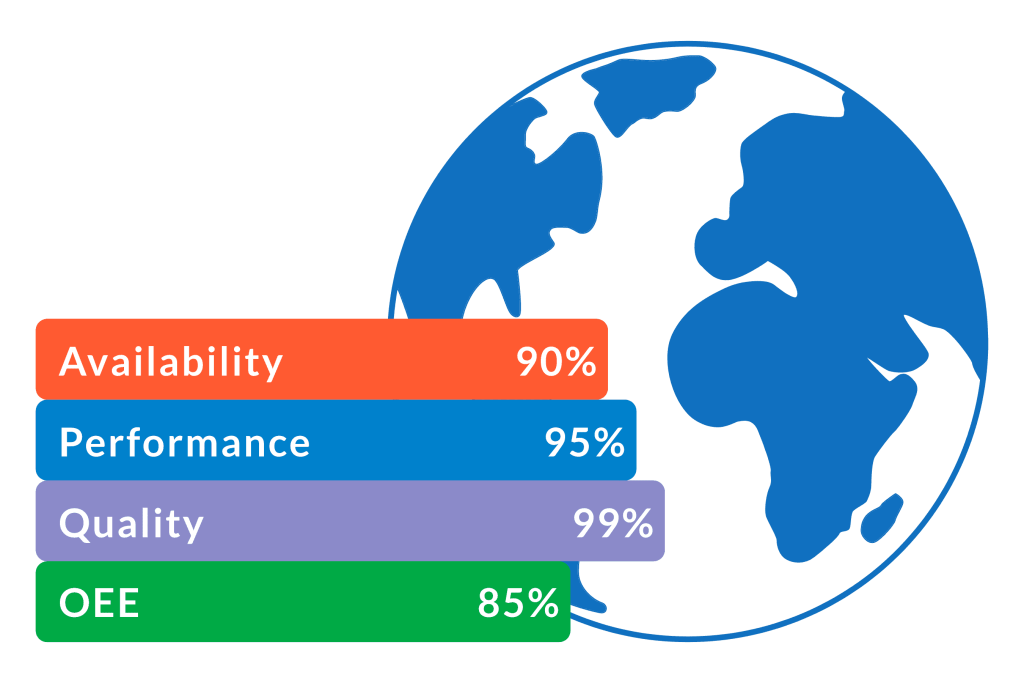
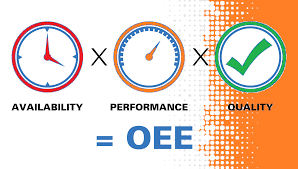
OEE provides a comprehensive view of how well manufacturing equipment is running by measuring three key factors:

  • Availability – Is the machine running when it should?

  • Performance – Is it running at its maximum speed?

  • Quality – Is it producing good quality output?

The goal of OEE is to identify losses, eliminate waste, and improve productivity.

🧮 How is OEE Calculated?

OEE is calculated using the formula:

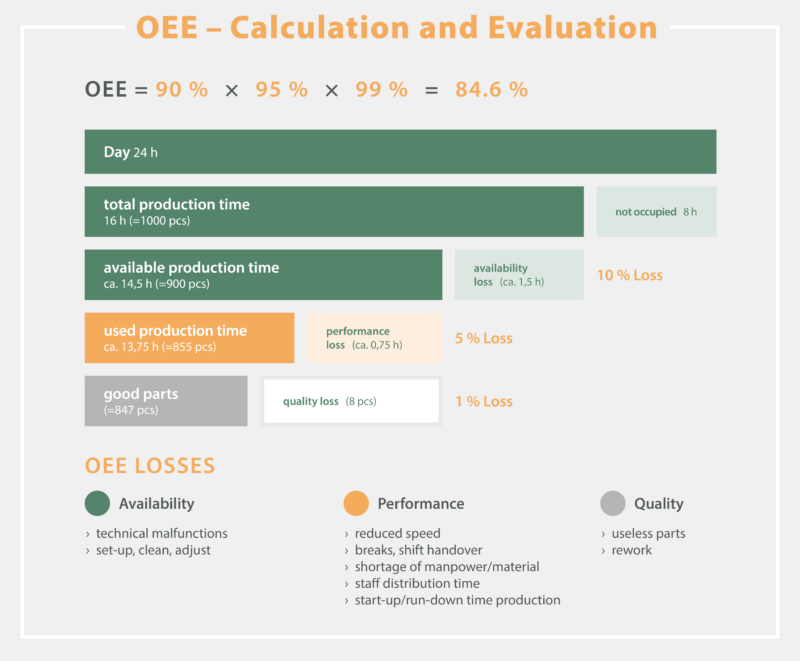
OEE (%) = Availability × Performance × Quality

Let’s break down each component:

✅ Availability

Measures the percentage of scheduled time that the equipment is actually available for production.

Availability = (Run Time / Planned Production Time)

It accounts for unplanned downtime such as breakdowns, setup time, or changeovers.

✅ Performance

Measures whether the equipment is running at its maximum designed speed.

Performance = (Ideal Cycle Time × Total Count) / Run Time

It reflects losses due to slow cycles, small stops, or reduced speed.

✅ Quality

Measures the percentage of good parts produced versus the total parts produced.

Quality = (Good Count / Total Count)

It accounts for defects, rework, or rejected parts.

Example:

Let’s say a machine has:

  • Availability = 90%

  • Performance = 85%

  • Quality = 95%

Then:
OEE = 0.90 × 0.85 × 0.95 = 0.72675 or 72.68%

An OEE score of 100% means perfect production: only good parts, as fast as possible, with no downtime.

🚧 Why OEE is Important

  • 📊 Benchmarking: Helps assess the current level of productivity and set realistic improvement goals.

  • 🔍 Root Cause Analysis: Identifies sources of inefficiency such as machine breakdowns or production bottlenecks.

  • 💰 Cost Reduction: Optimizes operations to reduce downtime, improve throughput, and minimize waste.

  • 🔄 Continuous Improvement: Forms the foundation for Lean Manufacturing, TPM (Total Productive Maintenance), and Six Sigma initiatives.

🛠️ OEE Solutions and Systems

Implementing OEE effectively requires the right tools, software, and systems that can collect data, analyze performance, and support decision-making.

1. OEE Monitoring Software

These systems collect real-time data from machines and calculate OEE automatically. Examples include:

  • Siemens Opcenter

  • AVEVA Insight

  • GE Digital Proficy

  • SensrTrx

  • OEE Studio

  • FactoryMES

They typically offer dashboards, reporting, alerts, and analytics to monitor production in real time.

2. Manufacturing Execution Systems (MES)

MES platforms often include OEE as a core feature. They connect production data with enterprise systems and help in scheduling, quality management, and traceability.

3. IoT and Edge Devices

With Industry 4.0, IoT sensors and edge devices can collect machine data like run time, cycle time, and defect rates automatically. This data feeds into OEE dashboards for live monitoring.

4. SCADA Integration

SCADA systems can be configured to provide the data needed for OEE calculation. When integrated, SCADA can help visualize machine availability, speed, and production counts.

5. Customized Dashboards & KPIs

Companies can also build customized OEE dashboards using tools like Power BI, Tableau, or custom web apps connected to PLCs and sensors.

🔧 How to Improve OEE – Practical Steps

Improving OEE is a continuous process that involves collaboration between production, maintenance, and quality teams.

Tips to Improve Availability:

  • Implement preventive and predictive maintenance.

  • Reduce setup and changeover times using SMED (Single Minute Exchange of Die).

  • Track unplanned downtime causes and eliminate root issues.

Tips to Improve Performance:

  • Ensure operators are trained to run machines at optimal speed.

  • Eliminate micro-stops and unnecessary delays.

  • Upgrade outdated equipment or software.

Tips to Improve Quality:

  • Improve quality control processes and feedback loops.

  • Analyze and reduce the causes of defects.

  • Automate inspection processes with sensors or vision systems.

📈 What is a Good OEE Score?

  • 85% and above: World-class (very few factories achieve this)

  • 60–85%: Good, with room for improvement

  • Below 60%: Opportunity for significant gains

Remember, the goal is not just to improve the number, but to identify and eliminate losses across all dimensions.

✅ Final Thoughts

OEE is more than just a number—it’s a window into the health and productivity of your manufacturing operation. By measuring availability, performance, and quality, OEE empowers manufacturers to pinpoint inefficiencies, reduce costs, and drive continuous improvement.

With the right OEE systems, software solutions, and improvement strategies, companies can transform their production lines, maximize equipment usage, and stay competitive in today’s dynamic market.

Need help selecting or implementing the right OEE system for your factory?
📞 Contact our industrial automation experts today and schedule a free consultation.

What is the SCADA System

What is the SCADA System? A Complete Guide to Supervisory Control and Data Acquisition

In today’s modern industrial landscape, automation and data play a vital role in streamlining processes, improving productivity, and ensuring safety. One of the core technologies enabling this transformation is SCADA, which stands for Supervisory Control and Data Acquisition.

But what exactly is a SCADA system, how does it work, and why is it essential in industries like manufacturing, energy, water treatment, oil & gas, and transportation?

In this blog, we’ll explore everything you need to know about SCADA systems—from basic definitions to real-world applications.

what is scada

What is SCADA?

SCADA is a control system architecture that uses computers, networked data communications, and graphical user interfaces for high-level process supervisory management. It also integrates other peripheral devices such as programmable logic controllers (PLCs) and remote terminal units (RTUs) to control and monitor industrial processes.

In simple terms, SCADA helps operators monitor, control, and analyze real-time data from equipment and systems spread across large geographic areas or complex facilities.

Key Components of a SCADA System

A SCADA system is typically composed of the following core components:

1. Human-Machine Interface (HMI)

The HMI is the user interface that allows human operators to interact with the system. It provides a graphical visualization of processes, alerts, and controls.

2. Supervisory System (SCADA Software)

This is the central control unit, often installed on a computer or server. It gathers and processes data, issues commands, and logs events.

3. Remote Terminal Units (RTUs)

RTUs collect data from sensors and devices and send it back to the supervisory system. They also receive control signals to execute certain actions.

4. Programmable Logic Controllers (PLCs)

PLCs are industrial digital computers that control machinery and processes. They are often used instead of RTUs in modern SCADA setups due to their flexibility and reliability.

5. Communication Infrastructure

This includes all networks (wired or wireless) that enable data transfer between devices and the central SCADA server.

How Does a SCADA System Work?

The SCADA system operates in a continuous cycle:

  1. Data Collection: Sensors and instruments collect real-time data from industrial equipment.

  2. Data Transmission: RTUs or PLCs transmit the collected data to the SCADA software.

  3. Data Processing: The SCADA system processes the data and displays it via the HMI.

  4. Operator Action: Based on the displayed data, operators can make decisions or automate responses.

  5. Control Commands: The SCADA system sends control signals back to the field devices to adjust processes as needed.


Benefits of Using a SCADA System

SCADA systems offer numerous benefits, including:

Real-Time Monitoring – Instant visibility into system performance and issues
Remote Access – Monitor and control processes from any location
Improved Efficiency – Automation reduces manual labor and operational errors
Predictive Maintenance – Identify and fix issues before they cause downtime
Data Logging & Analysis – Historical data helps with reporting, auditing, and optimization
Enhanced Safety – SCADA can trigger alarms and emergency shutdowns in hazardous conditions

Applications of SCADA in Industries

SCADA is used across a wide range of industries:

  • Energy & Power: Grid monitoring, power generation, substations

  • Water & Wastewater: Water treatment, distribution networks

  • Oil & Gas: Pipeline monitoring, offshore platforms, storage tanks

  • Manufacturing: Process control, quality management, equipment maintenance

  • Transportation: Railway systems, traffic control, airport operations

  • Building Management: HVAC, lighting, fire systems in smart buildings

Challenges and Future of SCADA

Despite its benefits, SCADA systems face challenges such as:

  • Cybersecurity Risks: SCADA systems are increasingly targeted by cyberattacks

  • Integration Complexity: Combining legacy and modern equipment can be difficult

  • Scalability Issues: Traditional SCADA systems may struggle to scale with IoT demands

Future Trends:

  • Cloud-based SCADA: Allowing global access and improved scalability

  • Integration with AI & IoT: Smarter decision-making and automation

  • Enhanced Security Protocols: Protecting critical infrastructure

Conclusion

SCADA systems are the backbone of modern industrial control. They enable organizations to monitor, analyze, and automate critical operations across diverse sectors. As industries move toward Industry 4.0, SCADA systems will continue to evolve, incorporating advanced technologies like cloud computing, machine learning, and the Internet of Things (IoT).

Whether you’re a plant operator, an engineer, or a business owner, understanding SCADA systems is essential to harnessing the power of industrial automation and staying competitive in a rapidly digitizing world.

Want to learn more about SCADA implementation or need a customized solution for your industry?
📞 Contact our experts today for a free consultation!

Boone Process Automation

Boone Process Automation:

Optimize your industrial processes with Boone Process Automation solutions. Enhance efficiency, reduce costs, and improve reliability. Specializing in Request a demo today! In an increasingly complex industrial landscape, the pursuit of operational excellence hinges on the intelligent application of technology. “Boone Process Automation” emerges as a distinctive paradigm within this domain, representing a commitment to transforming conventional industrial processes into agile, efficient, and resilient automated ecosystems. More than just integrating machinery and software, Boone Process Automation embodies a philosophy that intertwines cutting-edge technology with a deep understanding of human operational needs and sustainable practices, making it a pivotal partner for industries striving for the next level of performance.

Boone Process Automation

At its core, Boone Process Automation is about leveraging advanced control systems, robotics, artificial intelligence, and data analytics to optimize every facet of a production or operational workflow. It’s about moving beyond simple mechanization to create truly intelligent systems that can adapt, learn, and self-optimize, driving unprecedented levels of productivity, quality, and safety.

The Distinctive Approach of Boone Process Automation

What sets Boone Process Automation apart is its multifaceted and often bespoke approach, built upon several key tenets:

  1. Human-Centric Design & Collaboration: Unlike purely technological implementations, Boone Process Automation emphasizes the symbiotic relationship between human operators and automated systems. Solutions are designed not just for efficiency but also for ease of use, enhanced safety, and augmented decision-making capabilities for the workforce. This involves intuitive Human-Machine Interfaces (HMIs), clear data visualization, and automation that empowers, rather than replaces, human ingenuity. The philosophy is to free human talent from mundane, repetitive, or hazardous tasks, allowing them to focus on innovation, problem-solving, and strategic oversight.
  2. Adaptive Intelligence & Machine Learning Integration: Boone Process Automation goes beyond fixed logic. It incorporates Machine Learning (ML) algorithms that allow systems to learn from real-time operational data, identify patterns, and predict future outcomes. This enables:
    • Predictive Maintenance: Anticipating equipment failures before they occur, reducing unplanned downtime.
    • Process Optimization: Continuously fine-tuning parameters to achieve optimal efficiency, energy consumption, and product quality.
    • Anomaly Detection: Identifying subtle deviations that could indicate impending issues, allowing for proactive intervention.
  1. Holistic Digital Integration (Industry 4.0 & IIoT): A hallmark of Boone Process Automation is its commitment to seamless digital integration. This involves:
    • Industrial Internet of Things (IIoT): Deploying smart sensors and connected devices across the operational footprint to collect vast amounts of data in real-time.
    • Digital Twins: Creating virtual replicas of physical assets and processes, enabling simulations, predictive modeling, and remote monitoring for informed decision-making.
    • MES/ERP Integration: Connecting automation layers with Manufacturing Execution Systems (MES) and Enterprise Resource Planning (ERP) systems to ensure end-to-end visibility, optimized scheduling, and streamlined resource management.
  1. Robust Cybersecurity & Data Integrity: Recognizing the inherent risks of interconnected systems, Boone Process Automation places paramount importance on cybersecurity. Implementing multi-layered security protocols, continuous monitoring, and proactive threat detection ensures the integrity and resilience of automated operations, protecting valuable data and critical infrastructure from cyber threats.
  2. Scalability and Future-Proofing: Solutions are designed with scalability in mind, allowing businesses to expand operations or adapt to new technologies without fundamental overhauls. This future-proofing approach ensures that investments in automation remain relevant and valuable over the long term, accommodating evolving market demands and technological advancements.

Applications Across Industries

The principles of Boone Process Automation find application across a diverse range of industries, delivering transformative results:

  • Manufacturing: From discrete assembly to continuous process manufacturing (chemicals, pharmaceuticals, food & beverage), automation optimizes production lines, enhances quality control, and improves supply chain responsiveness.
  • Energy & Utilities: Automating power generation, distribution, and smart grid management, along with water treatment and delivery systems, for greater efficiency, reliability, and safety.
  • Mining & Metals: Enhancing safety in hazardous environments, optimizing material handling, and improving resource extraction and processing efficiency.
  • Logistics & Warehousing: Implementing automated guided vehicles (AGVs), robotic picking systems, and intelligent warehouse management for faster throughput and reduced operational costs.
  • Agriculture (Agri-tech): Automating irrigation, precision farming, and crop monitoring to enhance yields and resource efficiency.

The Boone Advantage: Beyond Technology

The true ‘Boone Advantage’ lies not just in the deployment of advanced technology, but in the strategic partnership and deep domain expertise that accompanies it. This includes:

  • Consultative Approach: Working closely with clients to understand their unique challenges, pain points, and strategic objectives before designing tailored automation solutions.
  • End-to-End Implementation: Providing comprehensive support from initial assessment and system design to installation, commissioning, training, and ongoing maintenance.
  • Performance Monitoring & Continuous Improvement: Implementing systems for continuous performance monitoring and leveraging data analytics to identify further opportunities for optimization and efficiency gains.
  • Sustainability Focus: Designing automation solutions that contribute to reduced energy consumption, minimized waste, and optimized resource utilization, aligning with global sustainability goals.

The Future Through Boone Process Automation

As industries navigate the complexities of global competition, supply chain volatility, and environmental pressures, the role of intelligent automation becomes increasingly critical. Boone Process Automation stands at the forefront of this evolution, offering not just technological solutions but a strategic pathway to smarter, safer, and more sustainable operations. By embracing an approach that values human collaboration, adaptive intelligence, and holistic digital integration, Boone Process Automation is poised to shape the future of industrial efficiency, empowering businesses to thrive in the era of intelligent manufacturing.