
What Role Does AI Play in a Future-Ready Warehouse Management System?
The traditional warehouse is evolving from a static storage space into a dynamic, thinking ecosystem. As global supply chains face increasing complexity—driven by same-day delivery expectations and labor shortages—Artificial Intelligence (AI) has shifted from a “nice-to-have” to the foundational brain of a Future-Ready Warehouse Management System (WMS).
Here is an in-depth look at how AI is transforming warehousing from the ground up.
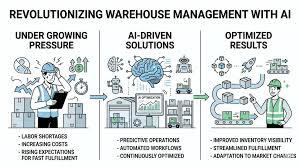
1. Predictive Demand Sensing & Inventory Intelligence
Traditional systems react to data; AI-powered systems anticipate it. Instead of just tracking what is on the shelf, a future-ready WMS uses Machine Learning (ML) to forecast what will be needed.
- Dynamic Reorder Points: AI analyzes historical sales, seasonal trends, and even external factors like weather or local events to adjust safety stock levels in real-time.
- Waste Reduction: For industries like FMCG or pharmaceuticals, AI tracks expiration dates and batch data to optimize “First-Expired, First-Out” (FEFO) strategies, significantly reducing spoilage.
2. Intelligent Slotting and Space Optimization
One of the biggest hidden costs in a warehouse is “travel time”—the distance workers or robots travel to pick items. AI turns the warehouse into a giant game of Tetris that rearranges itself for maximum efficiency.
- Heat Mapping: AI identifies “hot” (fast-moving) items and suggests moving them closer to packing stations.
- Velocity-Based Slotting: As trends change (e.g., a sudden viral product), the AI-driven WMS automatically updates the slotting plan to prevent bottlenecks in high-traffic aisles.
3. Orchestrating the “Human-Machine” Symphony
In a modern facility, robots (AMRs) and humans work side-by-side. AI acts as the air traffic controller for this hybrid workforce.
- Pick-Path Optimization: AI calculates the most efficient route for every pick, reducing walking distances by up to 30–50%.
- Task Interleaving: The system intelligently assigns “combined” tasks—for example, directing a worker to drop off a return while on their way to pick a new order—minimizing “deadhead” or empty-handed travel.
- Computer Vision: AI-enabled cameras can instantly verify that the right item was picked or detect if a package is damaged before it leaves the dock.
4. Predictive Maintenance: Eliminating Downtime
In a future-ready warehouse, equipment failure is caught before it happens. By integrating with IoT (Internet of Things) sensors, the WMS monitors the “health” of conveyor belts, forklifts, and robotic arms.
- Anomaly Detection: AI detects subtle vibrations or temperature spikes in machinery that suggest an imminent breakdown.
- Proactive Scheduling: Maintenance is scheduled during low-activity windows, ensuring the warehouse never grinds to a halt during a peak surge like Black Friday.
5. Agile Labor Management
Labor is often the highest variable cost in warehousing. AI helps managers move from reactive scheduling to proactive resource allocation.
- Workload Balancing: By analyzing the incoming order pool, AI predicts exactly how many people are needed in receiving vs. picking vs. packing for the next shift.
- Burnout Prevention: Smart systems can track worker fatigue or repetitive motion patterns to suggest task rotations, improving safety and long-term retention.
Summary: Traditional WMS vs. AI-Powered WMS
| Feature | Traditional WMS | AI-Powered WMS (Future-Ready) |
| Decision Making | Rule-based & Manual | Data-driven & Autonomous |
| Logic | Static (“If this, then that”) | Adaptive (Learning from patterns) |
| Problem Solving | Reactive (Fixes errors) | Predictive (Prevents errors) |
| Scaling | Difficult during peak surges | Seamless through automated orchestration |
The Bottom Line
The role of AI in a future-ready WMS is to move the operation from visibility (knowing what happened) to agility (knowing what to do next). For businesses looking to survive the “Amazon effect,” AI isn’t just about robots—it’s about the intelligence that makes every square foot and every second count.
Are you currently using a rule-based WMS, or are you exploring an upgrade to a more predictive, AI-driven platform?