
AI-Powered Dockyard Safety: Transforming Maritime & Logistics Hubs in North-West India
The maritime corridors and logistics hubs of North-West India—spanning the maritime hubs of Gujarat (Mundra, Kandla, Hazira, Pipavav) and Maharashtra (Jawaharlal Nehru Port Authority/JNPT, Mumbai Port) to inland container depots (ICDs) across Delhi-NCR, Haryana, and Punjab—are the primary economic engines of the nation’s trade. Handling millions of TEUs (Twenty-Foot Equivalent Units) and massive dry/liquid bulk volume annually, these facilities operate around the clock under intense operational pressure.
However, high throughput brings severe environmental hazards. Dockyards are dynamic ecosystems where heavy machinery, moving container handlers, automated equipment, and human personnel operate side-by-side in high-risk environments. Traditional safety oversight relies on manual inspections, post-incident CCTV review, and periodic audits—methods that are inherently reactive and unable to prevent real-time near-misses or structural non-compliance.
To address these challenges, AI-enabled dockyard safety systems featuring edge vision analytics, instant alerts, and automated control interlocks are transforming maritime logistics from reactive observation into proactive risk mitigation.
The Operational & Safety Realities of North-West Indian Docks
Managing dockyard and port terminal operations across Western and Northern India presents unique environmental and operational friction:
-
High Vehicle & Heavy Machinery Density: Heavy-duty equipment—such as Rubber-Tyred Gantry (RTG) cranes, reach stackers, terminal tractors, and heavy commercial vehicles—moves continuously through tight container stacking lanes. Visual blind spots around heavy machinery remain a primary cause of workplace incidents.
-
Extreme Regional Climates: Industrial port belts experience extreme weather—ranging from dense winter fog in Northern ICDs to intense coastal heat, dust storms, and heavy monsoon rains in Gujarat and Maharashtra. Ambient conditions often degrade human situational awareness and strain standard camera equipment.
-
Complex Multi-Zone Access Control: Distinguishing safe pedestrian paths from high-risk loading bays, gantry crane paths, and hazardous liquid chemical transfer docks is difficult to enforce purely through painted lines and warning signs.
-
Fatigue & High-Shift Volume: Round-the-clock operations lead to supervisor fatigue, allowing PPE non-compliance (missing helmets, high-visibility vests, or protective boots) or unsafe proximity events to go unnoticed during busy night shifts.
Architecture of AI-Enabled Dockyard Safety Systems
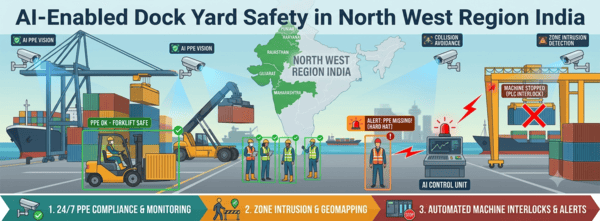
Modern AI dockyard safety platforms convert existing thermal and IP camera networks into continuous operational intelligence layers using Computer Vision, Deep Learning (YOLO/Convolutional Neural Networks), and Edge Computing:
[ CCTV / Thermal IP Cameras ]
              │
              ▼
  [ Edge AI Processing Unit ] ◄── (Computer Vision Models)
              │
      ┌───────┴────────────────────────────────┐
      ▼                                        ▼
[ Visual & Audible Alerts ]          [ PLC Control Interlock ]
 • Local Strobe Lights                • Gate Barrier Lockdown
 • Hooter / Voice Warnings            • Automated Crane Handoff Pause
 • Control Dashboard Notification      • Equipment Speed Limiting
1. Zone Intrusion & Pedestrian Protection (Geofencing)
-
Dynamic visual geofencing allows operators to define virtual “red zones” around hazardous equipment like reach stackers, gantry crane tracks, or hazardous cargo drop areas.
-
If a pedestrian crosses into an active machinery lane, the AI calculates collision trajectories in real time, triggering immediate audible sirens and warning lights to both the worker and driver.
2. Multi-Point PPE Compliance Detection
-
Advanced algorithms inspect personnel at gate entries, loading berths, and vessel yards to verify that hard hats, high-visibility reflective vests, safety goggles, and work boots are worn correctly.
-
The AI goes beyond binary detection to check proper fit under adverse lighting conditions, low light, or atmospheric dust.
3. Traffic Management & Speed Violations
-
Computer vision models track vehicle speeds, lane adherence, and unauthorized parking along critical dock pathways and berth access roads.
-
Real-time tracking flags over-speeding yard tractors or forklifts before they cause severe equipment damage or tipping incidents.
4. Direct Machine & Barrier Interlocking (PLC Integration)
-
For critical hazards, AI vision systems connect directly with hardware automation—such as Programmable Logic Controllers (PLCs), dock levelers, boom barriers, and equipment power relays.
-
Safety Lockout Logic: If a worker steps into a container-loading zone or vessel-side drop point without verified PPE, the AI signals the local PLC to halt crane movement or lock automated loading barriers until the hazard is cleared.
Strategic Value for Maritime & Logistics Operations
| Operational Objective | Impact of AI Safety Integration |
| Incident & Injury Reduction | Eliminates blind spots by providing continuous 24/7 visual monitoring across stack yards, berths, and ICD bays. |
| Downtime Minimization | Prevents equipment collisions and emergency shutdowns caused by workplace accidents, maintaining smooth vessel turnarounds. |
| Automated Compliance & Audits | Generates digital, time-stamped incident logs and visual audit trails for Directorate General of Shipping and EHS safety compliance. |
| Edge Hardware Reliability | On-site edge inference ensures sub-second alert latency without reliance on cloud network connections. |
Implementation Roadmap for Dock Facilities
-
Site Risk Mapping & Audit: Identify high-risk zones, such as vessel loading arms, rail-mounted gantry paths, truck receiving bays, and pedestrian crosswalks.
-
Infrastructure Retrofitting: Map existing IP cameras and install thermal/low-light cameras at critical docks and crane booms.
-
Edge AI & PLC Interlock Setup: Deploy edge analytics hardware on-site and integrate relay modules with barrier gates, warning strobes, and machinery PLCs.
-
EHS Dashboard Integration: Centralize analytics into an Environmental Health & Safety (EHS) operational dashboard for real-time monitoring and automated audit logging.
The Future of Smart Ports in Western and Northern India
As maritime terminals and logistics parks across Gujarat, Maharashtra, and Northern India scale to support larger cargo volumes, safety infrastructure must evolve alongside container capacity. Integrating Computer Vision AI with automated physical controls transforms safety from a static regulatory requirement into a dynamic, real-time operational layer.
By deploying AI-enabled PPE verification, collision prevention, and automated machine control, port operators and dock yard managers can ensure zero-harm environments while maximizing terminal throughput.