
Cloud-Based vs. On-Premises SCADA: Which Solution Fits Your Operations?
Supervisory Control and Data Acquisition (SCADA) systems serve as the core intelligence layer for modern industrial operations. They monitor real-time telemetry, manage sub-second process automation, and collect historian data across manufacturing plants, water utilities, energy grids, and oil extraction fields.
For decades, the standard deployment model was straightforward: build server racks on site, keep everything behind air-gapped perimeters, and run local Human-Machine Interfaces (HMIs). However, the rise of Industry 4.0, scalable cloud infrastructure, and IIoT devices has introduced Cloud-Based SCADA as a viable competitor to traditional On-Premises SCADA.
Choosing between cloud and on-premises deployment is no longer just an IT infrastructure preference—it directly impacts real-time latency, operational resilience, security postures, and long-term capital expenditure (CapEx) versus operational expenditure (OpEx).
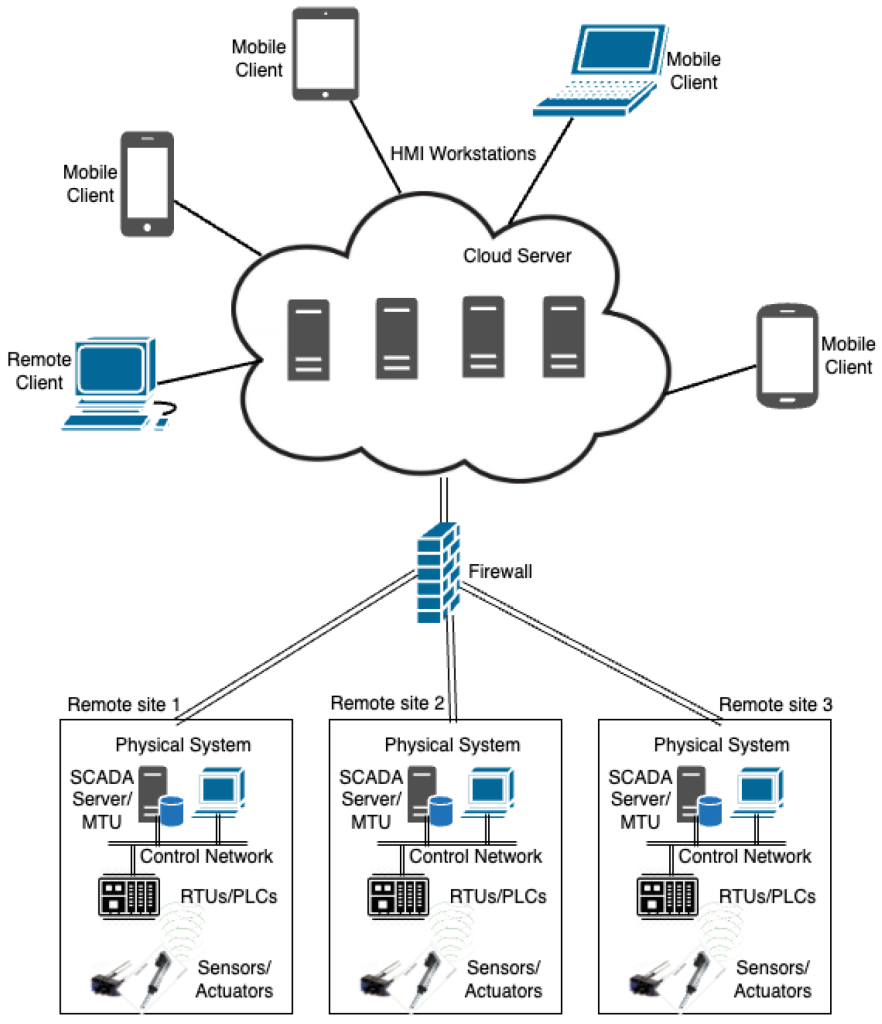
Understanding the Architectural Split
On-Premises SCADA
In an on-premises setup, all SCADA software, historians, database servers, and HMIs reside physically inside the facility or within a localized private data center. Local controllers—such as Programmable Logic Controllers (PLCs) and Remote Terminal Units (RTUs)—communicate directly with local servers via hardwired networks or dedicated local area networks (LANs).
Cloud-Based SCADA
In a cloud architecture, core supervisory logic, telemetry processing, historical databases, and web-based HMIs are hosted on public or private cloud infrastructure (such as AWS, Microsoft Azure, or specialized OT cloud platforms). Edge gateways aggregate telemetry at the field site and transmit data upstream over encrypted cellular, satellite, or wide-area network (WAN) links using lightweight protocols like MQTT or OPC UA Pub/Sub.
Core Evaluation Factors
1. Latency and Deterministic Real-Time Control
-
On-Premises: Delivers deterministic, sub-millisecond control loops. Because signal transmission stays within the local plant network, response times are unaffected by external internet connectivity. For high-speed discrete manufacturing, motion control, and safety trip systems, on-premises components remain essential.
-
Cloud-Based: Subject to network jitter and WAN latency (ranging from 20 ms to several hundred milliseconds). While cloud platforms excel at high-level monitoring, visualization, and analytics, they are rarely suited for direct, closed-loop safety controls without localized edge controllers taking local action.
2. Scalability and Multi-Site Visibility
-
On-Premises: Scaling requires buying more physical servers, configuring localized storage arrays, and manually deploying licenses per node. Multi-site aggregation often requires complex VPN setups and enterprise historian rollups.
-
Cloud-Based: Highly elastic. Adding a new remote pump station, wind turbine, or production line takes minutes rather than weeks. Centralized dashboards aggregate global operations into a single view, accessible from any verified web browser or mobile device.
3. Cost Model: CapEx vs. OpEx
-
On-Premises (CapEx Heavy): High upfront investment in server hardware, redundant power supplies, backup drives, software licenses, and physical rack infrastructure. Beyond initial setup, organizations bear ongoing costs for hardware refresh cycles every 5–7 years.
-
Cloud-Based (OpEx Heavy): Lower upfront entry barrier. Operates on a predictable subscription model (SaaS/PaaS) based on data ingest volumes, tag counts, or active users. It shifts financial risk away from upfront hardware purchases to operational budgeting.
4. System Maintenance and Patching
-
On-Premises: Internal OT and IT teams handle system maintenance, OS upgrades, security patching, database indexing, and disaster recovery backups. Upgrades often require planned operational downtime.
-
Cloud-Based: Managed by the cloud service provider. Infrastructure updates, database optimizations, and security patches occur continuously in the background without requiring local site downtime.
Detailed Comparison Matrix
| Decision Criteria | On-Premises SCADA | Cloud-Based SCADA | Hybrid SCADA (Edge-to-Cloud) |
| Primary Use Case | Millisecond real-time control, mission-critical safety | Distributed assets, multi-site analytics, remote monitoring | Plant-floor control + centralized enterprise analytics |
| Initial Investment | High (Server hardware & licenses) | Low (Gateway hardware & initial setup) | Moderate (Edge hardware + cloud sub) |
| Network Reliance | Independent of external internet | Depends strictly on WAN/Internet uptime | Local control functions offline; cloud syncs when connected |
| Maintenance Burden | High (In-house IT/OT team responsibility) | Low (Managed by provider) | Balanced (Edge managed locally/remotely; core in cloud) |
| Cybersecurity Focus | Perimeter defense, physical port security | Zero Trust, IAM, API security, and encryption | Micro-segmentation & secure edge-tunneling |
The Hybrid Approach: The Modern Industry Standard
Recognizing that neither pure cloud nor pure on-premises models fit every industrial scenario, many enterprises deploy a Hybrid SCADA Architecture.
In a hybrid model:
-
Critical Control Stays Local: PLCs, PACs, and localized edge HMIs manage real-time control loops and immediate emergency shutdowns on the plant floor.
-
Edge Gateways Buffer Data: Local edge compute devices store data locally during internet outages, preventing data loss.
-
Cloud Performs Heavy Lifting: Once connectivity is restored, telemetry streams to the cloud for historical storage, predictive maintenance modeling, machine learning, and executive dashboards.
Decision Framework: Which Solution Fits Your Operations?
Choose On-Premises SCADA if:
-
Your processes require sub-second deterministic response times where network latency poses a physical safety risk.
-
You operate in remote regions with unstable, high-latency, or air-gapped internet connectivity.
-
Regulatory compliance mandates that operational data must physically remain within site boundaries.
Choose Cloud-Based SCADA if:
-
You manage geographically distributed assets (e.g., municipal water distribution, smart agriculture, oil wells, or logistics hubs).
-
You require rapid deployment without managing physical server infrastructure.
-
Your priority is enterprise-wide data accessibility, mobile asset tracking, and central dashboarding.
Choose Hybrid SCADA if:
-
You want the reliability of local control combined with the analytics power and multi-site visibility of the cloud.
-
You are modernizing a legacy plant step-by-step without replacing existing PLCs.