
The Silent Sentinel: Why PPE Detection is the Future of Industrial Safety
In the high-stakes environment of a factory floor, a construction site, or a chemical plant, the line between a routine shift and a life-altering accident is often just a few millimeters thick. That thickness belongs to Personal Protective Equipment (PPE).
Despite rigorous training and strict protocols, human error remains a constant variable. This is where Automated PPE Detection—powered by AI and computer vision—steps in. It isn’t just a “nice-to-have” tech upgrade; it’s becoming the backbone of modern industrial health and safety (EHS) strategies.
The Reality of the “Safety Gap”
We’ve all seen it: a worker removes their helmet for a moment to wipe sweat, or a technician forgets their safety glasses because they’re “just doing a quick check.” These micro-moments of non-compliance create a Safety Gap.
Traditional safety audits are periodic and manual—like taking a polaroid of a moving train. PPE detection systems, however, provide a continuous video stream of data, ensuring that safety is maintained every second of every shift.
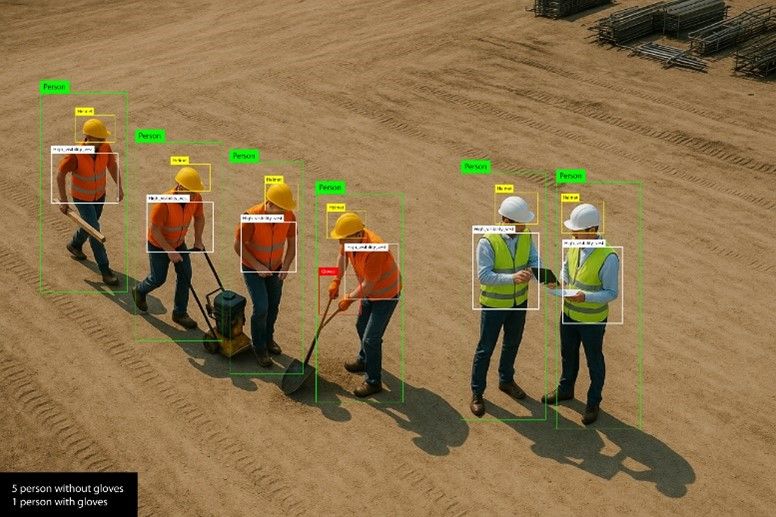
Why PPE Detection is Non-Negotiable
1. Real-Time Risk Mitigation
The primary goal of PPE detection is prevention. When a system identifies a worker entering a hazardous zone without a high-visibility vest or a hard hat, it can trigger instant alerts.
-
Immediate Feedback: Audio visual alarms can notify the worker instantly.
-
Proactive Intervention: Supervisors receive mobile alerts to address the issue before an incident occurs.
2. Data-Driven Safety Culture
You can’t manage what you don’t measure. PPE detection transforms “safety” from a feeling into quantifiable data.
-
Trend Analysis: Are workers consistently forgetting gloves on Tuesdays? Is there a specific zone where compliance drops?
-
Targeted Training: Instead of lecturing the whole team, EHS managers can provide specific coaching to individuals or departments where the data shows a lapse.
3. Enhancing Operational Efficiency
It sounds counterintuitive, but better safety leads to better speed.
-
Reduced Downtime: Every accident leads to an immediate halt in production, investigations, and potential equipment damage.
-
Lower Insurance Premiums: Demonstrating a tech-forward approach to safety often allows companies to negotiate better rates with insurers who value lower risk profiles.
4. Regulatory Compliance and Liability
In many jurisdictions, “I didn’t know they weren’t wearing it” is not a valid legal defense.
-
OSHA/HSE Standards: Automated logs provide an audit trail showing that the company took every possible step to enforce safety standards.
-
Legal Protection: In the event of a claim, having timestamped evidence of safety protocols helps protect the organization from negligence charges.
How the Technology Works
Modern PPE detection utilizes Deep Learning models trained on thousands of images of safety gear. These models are integrated with existing CCTV infrastructure to monitor:
-
Head Protection: Hard hats and helmets.
-
Eye & Face: Safety goggles and face shields.
-
Body: High-visibility vests and hazmat suits.
-
Extremities: Gloves and steel-toed boots.
Beyond the “Big Brother” Stigma
One hurdle in implementing this tech is the “surveillance” feel. However, the most successful implementations focus on safety, not punishment. When framed as a “digital guardian” that ensures everyone goes home to their families at night, worker buy-in increases significantly.
Summary Table: Manual vs. Automated Safety
| Feature | Manual Audits | AI PPE Detection |
| Frequency | Periodic / Random | 24/7 Continuous |
| Response Time | Delayed (Post-audit) | Real-time (Instant) |
| Data Accuracy | Subjective / Human Error | Objective / Data-driven |
| Cost over time | High (Labor intensive) | Low (Scalable) |
The Bottom Line
In the industrial world, equipment can be replaced, and deadlines can be pushed. Human life cannot. PPE detection is the bridge between safety policy and safety reality. By leveraging AI to watch over the workforce, companies aren’t just checking a box—they are building a culture of care.