The Prevention Revolution: Can PPE Detection Truly Reduce Workplace Accidents?
In high-risk industries like construction, oil and gas, and manufacturing, “safety first” is a slogan painted on every wall. Yet, despite the presence of high-tech gear and rigorous training, the International Labor Organization (ILO) reports approximately 60 million accidents annually due to negligence in using Personal Protective Equipment (PPE).
The question isn’t whether PPE works—we know it does. The question is: Can we ensure it is actually worn? Recent data from 2025 and 2026 suggests that AI-powered PPE detection is no longer just a trend; it is a life-saving necessity that is slashing accident rates by up to 70%.
The Anatomy of an Accident: Why Manual Monitoring Fails
Before we look at the solution, we must understand the “Safety Gap.” On a busy site, a safety officer cannot be everywhere at once.
-
Human Inconsistency: Supervisors get distracted, fatigued, or may have “blind spots” in large facilities.
-
The “Observer Effect”: Workers often don’t their gear the moment they see a supervisor approaching, only to remove it once the “threat” of a write-up passes.
-
Reactive vs. Proactive: Traditional safety audits happen after a shift or after an accident. They tell you what went wrong, but they don’t stop the injury in progress.
How PPE Detection Acts as a “Digital Guardian”
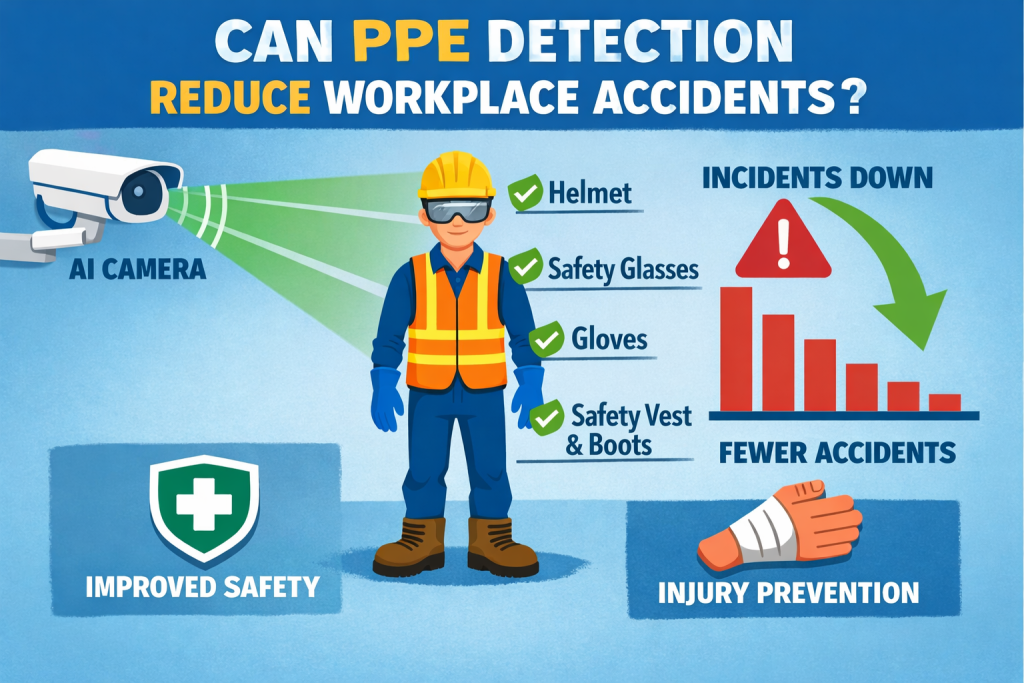
PPE detection uses Computer Vision (CV)—a branch of AI that allows cameras to “see” and interpret the world. By integrating with existing CCTV, these systems perform a continuous, three-step safety check:
-
Identification: The AI identifies a human shape in a designated hazard zone.
-
Verification: It scans for specific pixels representing a hard hat, high-vis vest, gloves, or safety glasses.
-
Action: If a piece of gear is missing, the system triggers an immediate response—whether that’s an audible alarm, a notification to a supervisor, or even locking an automated gate to prevent entry.
Proven Impact: The Statistics of 2026
The transition from manual checks to AI-driven monitoring has yielded staggering results across various sectors:
| Industry | Impact of PPE Detection | Key Outcome |
| Power Plants | 89% Reduction in safety alerts | Proactive detection stopped violations before they escalated. |
| Construction | 70% Fewer Falls | Automated harness and helmet checks ensured 24/7 compliance. |
| Manufacturing | 95% Compliance Rate | AI-driven verification reached near-perfect adherence levels. |
| Food Processing | 100% Mask Compliance | Eliminated hygiene-related contamination risks. |
Beyond Just “Wearing the Gear”
Reducing accidents isn’t just about spotting a missing helmet. Modern systems in 2026 have evolved to detect Safety Behavior:
-
Zonal Awareness: Detecting if a worker is wearing the correct class of PPE for a specific high-risk zone (e.g., specialized gloves for chemical handling vs. standard work gloves).
-
Equipment Integrity: Advanced models can now spot a cracked hard hat or a frayed safety vest that has lost its reflective properties.
-
Fatigue & Posture: By analyzing body mechanics, AI can predict if a worker is too tired to operate machinery safely, preventing accidents caused by human exhaustion.
The ROI of a Safer Workplace
Critics often point to the initial cost of AI implementation. However, the 2026 market data shows that the Return on Investment (ROI) is rapid:
-
Lower Insurance: Companies using automated PPE detection are seeing significant discounts on premiums due to “demonstrable risk mitigation.”
-
Avoided Penalties: In the US, OSHA fines for “willful violations” can exceed $160,000 per instance. Automated logs prove a company’s commitment to safety, often mitigating these legal risks.
-
Uptime: Fewer accidents mean fewer shutdowns. A single major accident can halt production for days; AI detection keeps the line moving safely.
Conclusion: A Cultural Shift
Can PPE detection reduce workplace accidents? The evidence is a resounding yes. By removing the element of human error and providing a “Safety-as-a-Service” layer that never sleeps, industries are moving toward the goal of Zero Harm.
This isn’t about surveillance; it’s about making sure that every worker who clocks in also clocks out—safe, sound, and whole.