
Automating Factory Gate Access: Integrating AI Face Mask Compliance with Turnstiles and SCADA Systems
In high-compliance manufacturing sectors—such as pharmaceuticals, food and beverage processing, specialty chemicals, electronics assembly, and automotive paint shops—respiratory and hygiene protection starts the second an employee steps onto the shop floor. A single unmasked worker entering a sterile cleanroom or hazardous fume zone can ruin an entire production batch, trigger severe occupational health incidents, or fail a regulatory audit.
For decades, enforcing mask compliance at factory entry points relied on security guards stationed at gates or supervisors performing manual spot checks during shift changes. When hundreds of workers clock in simultaneously during peak shift handovers, manual verification creates bottlenecks, causes human error, and leaves compliance gaps.
By integrating AI-Based Face Mask Compliance directly with automated turnstiles, boom barriers, and plant SCADA/PLC systems, industrial facilities can transform gate entry from a manual bottleneck into a fast, touchless, and fail-safe perimeter control system.
Why Manual Gate Checks Fail in Modern Manufacturing
Traditional access control—such as RFID swipe cards or biometric fingerprint scanners—verifies who a person is, not whether they are safe to enter. Relying on manual human oversight alongside standard access readers creates critical vulnerabilities:
-
Shift-Change Bottlenecks: Hundreds of workers arriving within a 15-minute window overwhelm security personnel, leading to rushed visual checks or waved-through entries.
-
Improper Mask Usage: Workers may wear a mask below their nose or chin to pass a quick glance, defeating respiratory or contamination protection once inside the facility.
-
Lack of Hardware Enforcement: Standard CCTV cameras can record a violation, and basic software can flash a screen warning, but neither physically stops a non-compliant worker from walking onto the production floor.
-
Audit & Traceability Gaps: Paper registers and unlinked camera footage make it difficult to prove 100% entry compliance during ISO, GMP, FDA, or EHS inspections.
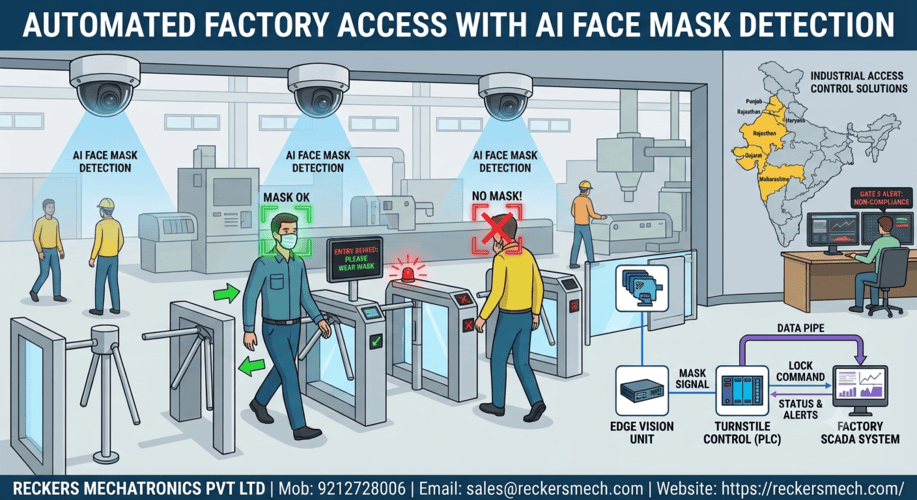
System Architecture: How AI Vision Connects to Turnstiles and SCADA
An automated gate access solution links high-speed Edge AI vision with physical electro-mechanical barriers and centralized plant automation. Rather than operating as an isolated IT tool, the vision system acts as a real-time field sensor integrated into the plant’s control architecture.
[ Worker Approaches Gate ] ──► [ RFID / Biometric Authentication ]
                                              │
                                              ▼
                       [ Optical IP Camera + Edge AI Vision ]
                       (Verifies Mask/Respirator Presence & Fit)
                                              │
                     ┌────────────────────────┴────────────────────────┐
                     ▼ (Compliant)                                     ▼ (Non-Compliant)
      [ Relay / PLC Unlock Signal ]                     [ Turnstile Remains Locked ]
       • Turnstile / Speed Gate Opens                    • Local Voice & Strobe Alert
       • Entry Logged in SCADA/MES                       • Violation Logged in SCADA
1. Sub-Second Edge AI Detection & Fit Verification
High-definition IP cameras mounted at eye level above turnstiles or air-shower doors capture live video streams processed locally on an industrial Edge AI unit. Within milliseconds, deep learning models analyze:
-
Mask Presence & Type: Distinguishes between standard surgical masks, N95/FFP2 respirators, cleanroom hoods, and industrial half-face respirators depending on the zone’s requirement.
-
Proper Placement: Detects whether both the nose and mouth are securely covered, flagging improperly worn masks (e.g., chin-straps or exposed noses).
-
Multi-Factor Pairing: Works alongside existing RFID badges, QR passes, or facial recognition terminals so identity and PPE compliance are verified in a single step.
2. Direct Electro-Mechanical Turnstile & Door Interlocks
Instead of stopping at a dashboard notification, the Edge AI controller outputs a dry-contact relay signal or industrial protocol command (such as Modbus TCP/IP, Profinet, or EtherNet/IP) directly to the gate hardware:
-
Compliant Entry: If both credentials and mask compliance pass, the controller triggers the solenoid lock on tripod turnstiles, optical flap barriers, full-height security gates, or cleanroom air-shower interlock doors.
-
Non-Compliant Lockout: If a mask is missing or worn incorrectly, the gate remains physically locked. An integrated display and audio speaker immediately instruct the worker (“Please wear your mask properly to proceed”), allowing them to self-correct within seconds without guard intervention.
3. Deep Integration with Plant SCADA and MES
Connecting gate compliance directly into the facility’s SCADA (Supervisory Control and Data Acquisition) and MES (Manufacturing Execution System) elevates perimeter security into enterprise operational intelligence:
-
Centralized Control Room Visibility: EHS officers and shift supervisors monitor live gate compliance rates, active lockouts, and zone headcounts directly on their existing SCADA HMI screens.
-
Zone-Based Access Logic: SCADA rules can dynamically adjust gate requirements based on real-time plant conditions. For example, if a chemical reactor enters a high-risk venting phase or a cleanroom transitions to sterile batching, SCADA can automatically tighten gate AI rules from standard masks to full respirators.
-
Batch & Audit Traceability: Every entry event—complete with timestamp, gate ID, compliance status, and snapshot—is archived in the SCADA historian, creating an indisputable digital trail for regulatory audits.
Traditional Gate Control vs. AI + Turnstile + SCADA Integration
| Operational Factor | Manual Guard + Standard RFID | AI Vision + Turnstile + SCADA |
| Verification Scope | Identity only (RFID/biometric); visual PPE check is manual | Simultaneous identity and accurate mask/respirator fit check |
| Enforcement Mechanism | Verbal reminder; worker can still walk past | Hardware-locked turnstile/door prevents unauthorized entry |
| Throughput Speed | Slows down during shift changes; prone to guard fatigue | Sub-second edge inference keeps shift queues moving smoothly |
| Plant System Connectivity | Isolated access logs separate from production systems | Real-time SCADA/PLC telemetry, dynamic rules, and audit logs |
| Network Dependency | Varies by access server | 100% local Edge AI processing; zero cloud latency |
Key Industries Benefiting from Automated Gate Compliance
-
Pharmaceutical & Biotech Cleanrooms: Enforces strict gowning and mask protocols at air-shower entries before personnel reach sterile compounding or packaging lines.
-
Food, Beverage & Dairy Processing: Eliminates biological contamination risks at hygiene stations and high-care processing zones.
-
Chemical & Petrochemical Plants: Ensures operators entering hazardous vapor or dust corridors are equipped with required respiratory protection.
-
Electronics & Semiconductor Manufacturing: Protects sensitive cleanroom wafers and micro-components from human respiratory droplets and particulates.
Best Practices for Deploying AI Gate Access in Your Facility
-
Optimize Camera Angles and Lighting: Mount cameras directly in the worker’s line of approach at each turnstile lane with consistent, glare-free lighting to ensure high accuracy across all shifts.
-
Design for Ergonomic Throughput: Position the AI camera slightly ahead of the turnstile card reader so visual verification completes while the worker taps their badge, eliminating any pause in walking speed.
-
Establish Fail-Safe Emergency Overrides: Wire all AI-controlled turnstile relays into the plant’s Fire Alarm Control Panel (FACP) and emergency E-Stop circuits so gates automatically unlock during evacuations.
-
Partner with Industrial Automation Specialists: Successful deployment requires expertise in both computer vision and industrial control protocols (PLCs, relays, and SCADA integration) to ensure rugged, 24/7 shop-floor reliability.
Moving Toward Zero-Compromise Factory Perimeters
Automating factory gate access with AI face mask compliance removes the friction and human error inherent in manual safety enforcement. By uniting edge computer vision with physical turnstile interlocks and SCADA intelligence, industrial plants gain faster shift handovers, airtight regulatory compliance, and a reliable frontline defense for workforce health and product integrity.