
Can PPE Detection Systems Work in Real Time? The Future of Workplace Safety
In the high-stakes environments of construction, manufacturing, and oil and gas, “safety first” isn’t just a slogan—it’s a logistical challenge. Traditionally, ensuring that every worker is wearing their hard hat, high-visibility vest, and safety glasses has relied on manual inspections. But human eyes can’t be everywhere at once.
This brings us to a critical question for 2026: Can PPE (Personal Protective Equipment) detection systems actually work in real time?
The short answer is yes. Thanks to the convergence of advanced Computer Vision, Edge AI, and high-speed connectivity, real-time PPE monitoring is no longer a “future tech” concept—it is a deployed reality.
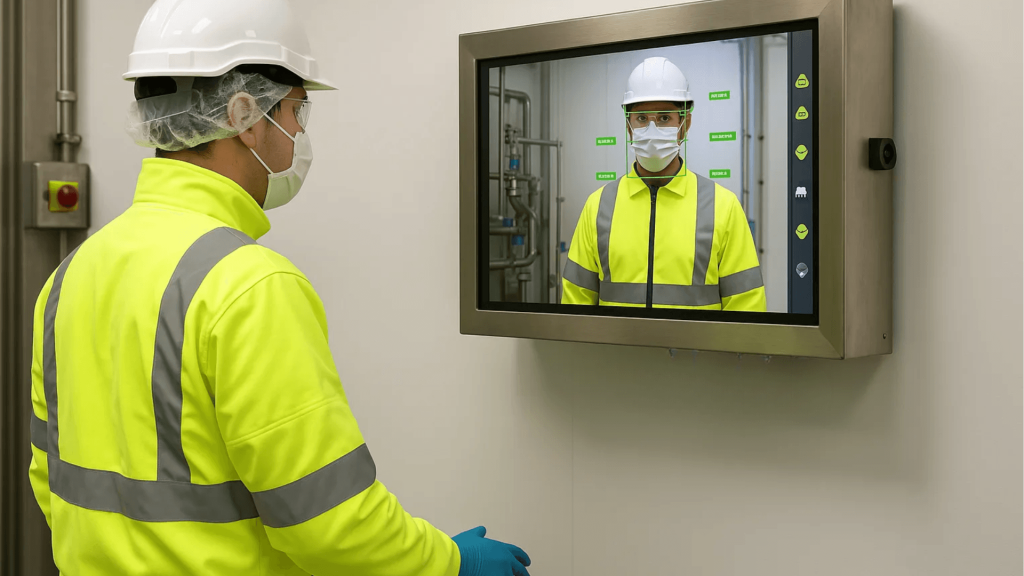
How Real-Time PPE Detection Works
Real-time detection isn’t just about recording video; it’s about instantaneous perception. The system uses a specialized branch of Artificial Intelligence called Computer Vision to “see” and interpret the environment.
The Technical Pipeline
1. Capture: Standard IP or CCTV cameras feed live video streams into the system.
2. Pre-processing: The system optimizes the frames, correcting for low light or motion blur.
3. Inference (The “AI” Moment): Deep learning models, such as YOLO (You Only Look Once) or SSD (Single Shot Detector), analyze the frame. Unlike older models that scanned an image multiple times, YOLO can identify humans and their gear in a single pass, often in less than 50 milliseconds.
4. Action: If a violation is detected (e.g., a worker enters a zone without a helmet), an alert is triggered immediately.
Key Benefits of Real-Time Monitoring
Moving from reactive (checking footage after an accident) to proactive (preventing the accident) changes the entire safety culture of a worksite.
• Instant Intervention: Supervisors receive mobile push notifications or SMS alerts immediately, allowing them to stop a dangerous task before an injury occurs.
• Automated Access Control: Some systems integrate with physical gates. If the AI doesn’t detect a hard hat and vest, the turnstile simply won’t open.
• Heatmaps and Hotspots: By tracking where violations occur most frequently, safety officers can identify “danger zones” that may need better signage or engineering controls.
• Night Vision & Harsh Conditions: Modern systems use IR (Infrared) and thermal imaging to detect PPE in rain, fog, or total darkness—conditions where human supervisors struggle.
The Challenges (and How We’re Solving Them)
While the tech is powerful, it isn’t magic. Real-world environments are messy.
• Occlusion: If a worker is standing behind a pallet, the camera might not see their boots. Solution: 2026 systems use multi-angle camera fusion to “stitch” together a 360-degree view of the worker.
• False Positives: A yellow t-shirt shouldn’t be mistaken for a safety vest. Solution: Modern models are trained on massive datasets (like the SH17 dataset) that include millions of variations in clothing, lighting, and angles to ensure accuracy rates often exceeding 95%.
• Privacy Concerns: Workers often feel “watched.” Solution: Many Edge AI systems offer “Privacy by Design,” where the video is processed and deleted instantly, only saving a blurred snapshot if a violation occurs.
Conclusion: A New Standard for 2026
In 2026, the question is no longer if these systems work, but how fast you can implement them. Real-time PPE detection transforms your existing CCTV cameras from passive observers into active digital guardians. It reduces insurance premiums, ensures OSHA/HSE compliance, and—most importantly—it saves lives.
“The goal of AI in safety isn’t to replace the safety officer, but to give them a thousand sets of eyes that never blink.”